REDISCOVER CARTOONING

Powerful images of a cartoon can be a quick and effective way to communicate one's idea. Humour touch with simplicity can connect best with many individuals. Through this blog, we hope one will be able to Rediscover the Power of Cartooning, embracing Greater Sense of Humour in Life!


Showing posts with label Cartooning Tip-Bits. Show all posts

Sunday, March 17, 2013

Cartooning Tip-Bits: Completed Comic Page


Computones are added using Photoshop which contributed to the final outcome of my comic page!

Cartooning Tip-Bits: Comic Page working in progress

 Stage Three. Outline your drawing in detail. Wait till your ink is dry before erasing off the pencil  marks. You may also erase digitally using Photoshop which I did here.


Stage Two. Pencil down your drawing. You may want to use a light blue pencil to draw if you do not
wish to erase heavily after inking. Try to draw (extend) the image outside the panel so that you see a fuller view of your character.


Stage One. It is always a good habit to start off with a draft. This is to pencil down your thought so that you know what to expect in your comic page.


Thursday, March 14, 2013

Cartooning Tip-Bits: Drawing Material


What you see here are "old school" stuffs. Yes I mean the pen, ink and ruler which nowadays may no longer be that important as compare to those days where having a computer for rendering is a previlege. However one still need to "draw" even though you are using the digital platform and most of the comics software still imitate the touch and feel of a G-pen or so. For me, I am still amazed by the flow of ink from a pen and how it transformed into a nice drawing.

Cartooning Tip-Bits: Comics Panel Basis


When deciding how to frame your images, think about these 3 panel format and the 3 viewpoints! These are not everything yet, what do you think I left out?


The real reasons behind every good comics, beside the story and the drawing, is about manipulation of time and space! You can slow down the time in a comics...

 just as you can speed up the time:)


Cartooning Tip-Bits: Drafting your Comic Strips


These extracts are taken from The Big Book of Cartooning. Once again Bruce Blitz had demonstrated how he pencil and ink his comic strip in a few simple steps. Although not everyone may do the same way as he did, it is still a good practice to have a basic structure to begin with.

Cartooning Tip-Bits: Speech Bubbles & Lettering


The following extracts are taken from The Big Book of Cartooning written by Bruce Blitz. There are many different types of speech bubbles (or balloon) and some evoked emotion. What you see are just some common examples and you can redesign the shape of your speech bubbles provided the readers understand what you trying to convey. Remember the readers can't hear (physical sound) what your characters are talking and the only clue that reflects the charcter's emotion or state of mind is the speech bubble and your selected text.

Cartooning Tip-Bits: Bruce Blitz's The Big Book of Cartooning


These extracts are taken from The Big Book of Cartooning, written by Bruce Blitz. His book can be purchased from Amazon and inside contains a lot of practical cartooning skill and knowledge. Most beginner may not see the link (or even interested) between the actual paper size we worked on and the scaled down size (printed version) until we decided to publish our comic strips. Think of it this way, it is better to draw big and reduced in scale according to the format of your book or paper.

Tuesday, March 12, 2013

Cartooning Tip-Bits: Drawing a representation of myself


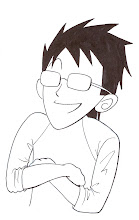
Who do you want to become? What do you want people to see in you? How are you going to do it? The answer may lies in these illustrations: Caricature - Cartoon - Manga.